|
ORGAN DONATION
There
are two eternal paths for any living being after he leaves
this body: the bright and the
dark. God vouches to every ‘Jiva’
a golden opportunity to attain the supreme abode from which
there is no return. On the other hand, the path
which leads to Brahma is comparatively dark from where he
returns to the mortal world i.e. he becomes a subject to birth
and death once more.
There are few acts in life that are nobler than
donating our organs. Donating our organs after we
gone is the closest that we can come to giving life to another
individual. Organ donation is a wonderful legacy we can leave
behind. The eyes continue to see the
wonders of the world and the heart continues to sing a new
song. The organs that a single person donates can give a new
lease life to many persons. Eye donation can give
precious sight to two individuals. Besides these various other parts can help repair other
organs. (It is possible for a single
donor to donate organs and tissues that may help as many as 60
recipients) Top
What is “Gift of
Life”?
When we lose the functioning of an organ
like kidney or a tissue like bone and skin it is possible put
another person’s organ or tissue and with modern surgical
techniques and drugs; it can be made to work. This is gifting
an organ after one ceases to need it any more. This known as
transplantation and it is the “Gift of Life”. Top
How successful is this treatment by
transplantation?
80 –
90% of patients who receive a kidney live for 5 years. Longest
survivor is 34 years. Receiving this new lease of life means
that the recipient will be free from continuous hospital
visits to receive dialysis. Top
How long one can live waiting for a
transplant?
In case of kidney failure, patient can be
maintained on regular dialysis. During a dialysis treatment,
the patient’s blood is filte. artificially. This treatment
is time consuming and is repeated 2-3 times every week for
life. In case of other organ failures like heart, lungs and
liver; patients can be kept alive only a short time on drugs,
unlike kidney failure patients; since there is no ‘dialysis
like’ treatment for other organs. Top
Which are the organs and tissues can be
used?
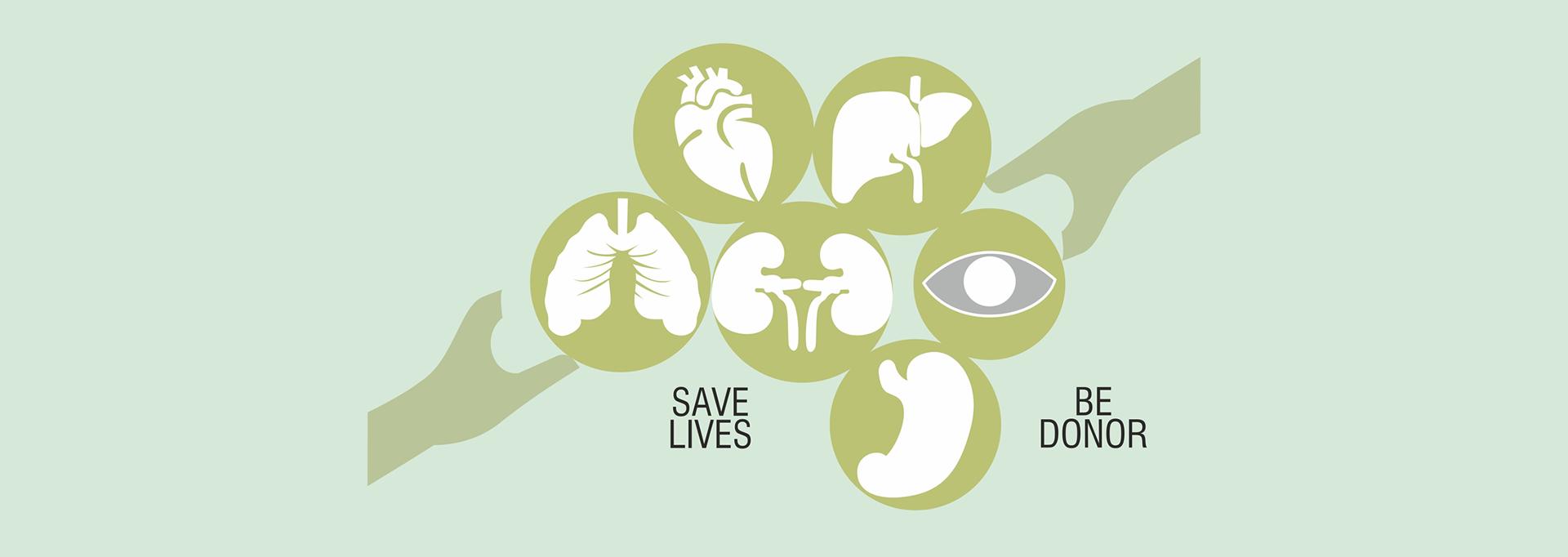
It is possible to transplant twenty-five
different organs and tissues including cornea, heart valves,
liver, kidneys, bone and cartilage, bone marrow, skin,
pancreas, lung intestine and more. Top
Aren’t these organs and tissues requi
to be used immediately?
No. These vital organs need to be
retrieved from a dead person immediately and can be preserved
up to various lengths of time by preservation techniques.
Heart and Lung can be preserved by 4-6 hours and kidneys 48 –
72 hours. Skin and bone may be preserved for 5 years or more. Top
Who requires these organs and
tissues?
Each of us has a number of vital organs
like brain, heart, kidneys, lungs, liver etc. Failure of any
organ means certain death. Except for the brain all other
organs can be replaced – which might be life saving. Besides
organs – many tissues like cornea, heart valve, skin and bone
may be used for repair and reconstruction. Top
Who can become a
donor?
Any person in good health if dies
suddenly, possibly through an accident or even other causes
like brain hemorrhag and who has been decla. ‘brain dead’
can be an organ donor. This is called the “cadaver donation”
in contrast to “live donation” which is possible only in
kidney and bone marrow. Top
What is brain death?
Normally the death is said to occur when
heart stops. But with modern technology the heart and lungs
canbe made to function through mechanical support even when
brain function has completely and permanently ceased. Thus
once brain death occurs; the person becomes a cadaver with a
beating heart. Top
How does one diagnose ‘brain death’?
In 1959, Neurosurgeons in Lyons (France)
found that deeply comatosed patients, who had sustained head
injury, never regained consciousness. Although their heart
continued to beat and kept their circulation going, these
patients were clinically dead. If their breathing support
machines were stopped, the heart also stopped. Thus a new
definition of death emerged. As this death was under
controlled circumstances (that is, in the intensive care unit
of hospitals) it was possible to retrieve some of their organs
such as kidneys, heart and liver after their relatives are
consented. In the west, the transplantation of organs from
brain dead patients is an accepted part of medical treatment
for quite some time. The government of India has now accepted
this new definition of death and has formulated the Human
organs transplantation act 1994 and hence it is legal to
diagnose and declare brain stem death. Top
How does brain death
occur?
Brain death usually results from a severe
head injury or bleeding in the brain that causes all brain
activity to stop. This can happen after a major road accident
or brain hemorrhage due to a stroke. This also can happen in
brain tumour. Top
How do doctors know a ‘brain dead’ patient
is really dead?
Four doctors from a panel recommended by
government, carry out a series of tests to confirm that a
patient is “brain stem dead”. The standards are very strict
and are accepted medically and ethically all over the world.
The four doctors are of following category;
1. Neuro Surgeon / Neuro Physician
2. Treating doctor
3. An other specialist as approved by
State Appropriate Authority
4. Medical Superintendent of the
hospital. Top
Will the doctors do everything to save
life if they know that a person is an organ donor and they can
transplant these organs to others?
Doctors who treat patients in life and
death situations have nothing to do with possible donation of
their organs and tissues. Every effort is made to save that
person’s life. Organ donation is not even conside. till that
person has died. Top
What is the difference between Brain Death
and Cardiac Death?
Brain death occurs when person’s brain has
permanently stopped. Cardiac death is said to occur when heart
stops beating. Both are legal declarations of death. Brain
death does not occur as often as cardiac death. Top
Are Coma and Brain death same
thing?
No. Coma is decrease in brain function and
thee is a chance that person may regain consciousness. Brain
death is irreversible loss of brain function. There is no
chance of recovery after brain death. Top
If someone is brain dead why does his
heart keep beating?
As long as heart has oxygen, it continues
to work. A mechanical ventilator provides enough oxygen to the
heart to keep it working. Without this mechanical support it
will stop beating. By giving brain dead patients oxygen making
their heart beat with medication controlling their Blood
Pressure, their organs continue to work. That is why brain
dead patients can be organ donors. This donation of organs may
not be possible if one dies out side the ICU. Without
Intensive Care all brain death is followed by cardiac arrest
within minutes. Only eyes, skin and other tissues can be
donated after the cardiac death. Top
Will donation cause pain and inconvenience
to one’s family?
Organ donation is often an immediate and
lasting consolation. It is often comforting to the family that
even though their loved one has died, one or more persons can
live on through their gift of life. Top
In case organs are donated, can one still
have normal funeral?
After someone dies, organs are surgically
removed as if the person were still alive. Careful attention
to incisions and scars is made so that he can still receive a
traditional burial or cremation. Top
Is donating organs is against religious
beliefs?
All major religious including Hinduism,
Protestant, and Roman Catholic, Islam, Buddhism and others
fully support organ and tissue donation. Top
Is there an age to donate organs?
Anyone is eligible to be an organ donor
depending on doctor’s decision. Tissues and organs
transplanted after death include corneas, heart, liver,
kidneys, bone and cartilage, bone marrow, skin, pancreas,
lungs and others. One can only donate kidneys and bone marrow
as a live donor. As per the norms and guidelines of Government
of Maharashtra organ donation can be done between 2 yrs to 65
yrs. Top
Can one donate while
alive?
Yes – only for kidneys and bone marrow.
God has given us two kidneys which are good enough for four
people. But only the near and dear ones are allowed to donate
and by law parents, siblings, son, daughter and spouse are
treated as ‘near relatives’. Top
Can only ‘near relatives’ donate while
alive?
Yes. That is the law. This law is to avoid
exploitation of poor people who want to donate their kidneys
for monetary benefits. However other relatives and friends can
donate as an ‘altruistic’ measure.
The state authorization committee headed
by DMER has to be satisfied that is it truly an altruistic
donation and no commercial interests are involved. Top
Is it safe to donate while alive?
Yes. The potential donor is made to
undergo rigorous evaluation before the person is accepted as
donor. Doctors cannot guarantee the success in recipient but
it is made sure that the donor comes to no harm. However
complications are known to occur in 1in 1000 surgeries. Top
But does the donor have a healthy life
afterwards?
As already mentioned one kidney is good
enough to sustain two people. In World War II it was seen that
a number of people who lost a kidney due to injury were
observed for years without any long term problems. Now the
live transplantation is being practiced all over the world
since 1954 and donors have been observed for about 50 years
without any ill effects. Top
Can anyone become a donor? What is the
minimum requirement to become a
donor?
The blood group should be non-interfering.
If the recipient is blood group ‘O’ – only ‘O’ can be a donor;
if the blood group is AB - any blood group O, A, B & AB
can be a donor. This is for live kidney donation. Rh group
(positive or negative is not conside. at all.
In cadaver organ donation the blood group
match is strictly adhe.. This is an ethical issue and ‘O’
group being an universal donor will always donate to all the
recipients of any blood group and the ‘O’ group recipient will
waiting for ever. Top
Is there any other matching between donor
and recipient besides the blood grouping?
Blood Grouping is the most important for
solid organ transplantation like kidney, heart or liver. The
tissue matching and cross matching have finer implications in
the long term graft survival. Top
What are the steps of donation after
death?
Once patient is admitted; all efforts are
made to stabilize the patients. If all efforts fail, patient
is pronounced brain-dead after evaluation, testing and
documentation. Consent from the family is obtained to proceed
with donation and organ procurement organization (OPO) is
informed. Consent from coroner/legal authorities is obtained.
In the mean time the organ donor is maintained on ventilator,
stabilized with fluids, medications and undergoes numerous
laboratory tests. Recipients are also identified for placement
of organs.
Surgical team are mobilized and
coordinated to arrive at hospital removal of organs and
tissues. Donor is brought to the operating room. Multiple
organ recovery is performed with organs being preserved
through special solutions and cold packing. Ventilator support
is discontinued. Donor’s body is surgically closed and
released. Top
What is organ procurement organization?
An organization is formed to improve organ
donations, procurement and transplantation system in the city,
state and the country. Thus in Sep. 1998; ZTCC (Zonal
Transplant Co-ordination Center) was formed in city of Mumbai.
Subsequently the same model will be adopted all over
Maharashtra. Top
What does ZTCC
do?
1. It helps in effective cadaver organ
procurement.
2. Increase patient access to state of art
transplant technology.
3. To improve system of sharing renal and
extra renal organs. This is done by:
a) Donor and recipient matching by specific criteria
established for each organ.
b) Improve transplant outcome.
c)
Provide a system by which immonologically sensitized patients
offe. best possible opportunities.
d) Decrease the wastage of organs.
4. Assure quality control by collection
analysis and publication of data on organ donation and
transplants.
5. Maintain and improve professional
skills of those involved in organ procurement and
transplantation.
6. To have immunosuppressive drug bank.
7. To increase public awareness. Top
What constitutes ZTCC?
ZTCC as organization was composed of every
recognized transplant institution of Mumbai. This includes 16
recognized hospitals including 3 municipal medical colleges, 1
government medical college, 1 central government Hospital
(INHS Asvini) and 11 private corporate hospital. Top
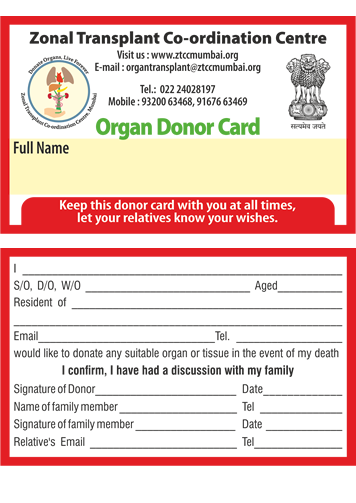
How does one become a
donor?
Once you have decided to become a donor,
the most important step is telling your family. Even if you
sign the ‘donor card’ – your family still has to consent
before organs are gifted. Top
Is it normal to get nervous when you
become a donor? What are the chances of actually donating?
An average male will live for 75 years and
female 80 years. The chances of becoming an organ donor in
real are quite small. Mumbai with a population of 1.2 crores;
about 600 deaths are due to vehicular deaths i.e. 1 in 20,000.
If whole of the city become willing donors – then may be there
will be 300 – 400 suitable donors. Top
Why do we keep hearing about ‘kidney trade
every few months? Is it because the doctors are greedy?
In India most of the transplants are from
live donors since cadaver donation is still in infancy due to
lack of public awareness. Hence there are a large number of
patients who have no suitable donor and hence look for
commercial donors.
All of such transplants are discouraged.
But patients in a situation of life and death do manage to
convince the doctors and the authorization committee.
Occasionally doctors do turn a blind eye in order to save
life.
Thus only long term solution to this
problem of ‘kidney racket’ is to have a viable cadaver
transplant program in the while country. Top
Why are so few cadaver transplants in the
country?
No cadaver transplant programme can be
successful unless there is time bound co-ordination amongst
intra hospital, inter hospital and the society at large.
Cadaver transplant activity is a hospital based activity with
participation of all strata of society. The core group, which
makes the donor organ functional in recipient, is the
transplant surgeons and the Nephrologists. They in turn are
dependant on entire hospital i.e. on intensives,
neurosurgeons, neurologists, administrators, anesthesiologists
in addition to service branches like pathology, microbiology,
imaging services. The role of Transplant coordinator is of
paramount importance; since coordinator is the first person
coming in contact with the grieving family. Top
Should I have a living related or cadaver
donor transplant?
A number of factors
enter into this decision, including success rates following
transplantation and the availability of donors. The best
results following transplantation are obtained with HLA –
identical (6 antigen matched) living related donors, which
almost always come from a sibling, rarely from a cadaver.
A major advantage of
living donor transplants is the ready availability of the
donor. This allows the transplant to be performed without a
long waiting period, as thee are currently more potential
recipients than available cadaver donors. For this reason, we
encourage living related donation whenever the family
situation is appropriate, and, if circumstances are correct,
donations for spouses. Top
How is a living related donor chosen?
Potential living related
donors usually are identified in discussions with your family
and your doctor. Tissue typing is then scheduled; the requi.
tests include blood group typing, HLA typing, and a mixed
lymphocyte culture. Based on these tests it is frequently
possible to identify the donor most likely to result in a
successful transplant. Choosing the donor is best done in
consultation with your doctor and the transplant team.
The selected donor is then
scheduled for admission to the hospital for a donor
evaluation. This evaluation is primarily on an out-patient
basis and involves a wide variety of tests to ensure the
health of the donor. Included in these tests is an
arteriogram, an x-ray procedure in which dye is injected into
the arteries supplying the kidney. This test allows the
surgeon to decide which kidney would be best to remove. After
completion of all tests, the physician responsible for the
donor evaluation, who is not a member of the transplant team,
will discuss the results with the potential donor privately.
Only donors who are healthy and have two completely normal
kidneys will be accepted. Top
Are there any risks to the donor?
The short term risks of
donation are those associated with major surgery, including
the risks of general anesthesia, wound infection, and the
possible need for a blood transfusion. These risks are very
small in healthy people. The donor evaluation process is
designed to identify any special factors which would place a
donor at increased risk; such donors would not be accepted.
The longer term risks are slightly more uncertain. Some
studies of donors 10 – 15 years following donation have
suggested a slightly higher incidence of mild high blood
pressure and protein in the urine; although these changes are
not particularly different from the general aging population.
The significance of these
studies is known, and there is not evidence of renal failure
in prior donors. The remaining kidney expands and takes over
the function previously performed by two. Because most kidney
diseases affect both kidneys simultaneously, the donor is not
at increased risk of kidney failure should he or she contract
such a disease. Donors are cautioned to avoid contract sports
or other activities which could cause major trauma to the
remaining kidney. We believe that donors will lead perfectly
normal lives. Top
What are the chances of my transplanted
kidney will work?
The success rate following
transplantation depends upon the closeness of the tissue match
between donor and recipient. A kidney from a brother or sister
with a “complete” match has a 95% chance of working gat the
end of one year. A kidney from a parent, child or
“half-matched” sibling has an 85% chance of working for at
least one year. Finally a cadaver donor kidney has an 80%
chance of working at least one year.
If you are having a repeat
transplant, the success rate will b3 10%-15% less. These
kidneys are not immortal, however, with 50% of cadaver kidneys
declining over 6 – 10 years, a rate faster than the relatively
stable success of related kidneys. Top
What happens if my new kidney fails?
If the transplant fails,
patients return to dialysis as before. The transplant will be
removed only if it is causing symptoms, such as fever or pain.
This is often necessary if the kidney fails soon after
transplant, but rarely does it fail after several months. You
may be able to have another transplant later, if you desire. Top
What are the chances that I will die as a
result of receiving a kidney transplant?
One of the major achievements
in the field of transplantation in the last ten years has been
a major .uction in the risk of death. Currently at this
hospital, the risk of death in the first year after a kidney
transplant is about 3 – 5%, occurring primarily in high risk
patients, particularly those over 60-65 and, to a less extend,
those with juvenile diabetes. This includes death from any
cause, whether or not related to the transplant. This risk is
not significantly different from that sustained during a year
of dialysis. During your transplant evaluation, any risk
factors you may have that will increase your risk for
transplantation will be identified and discussed with you. Top
How to prevent kidney failure?
Prevention is better than cure lost of
cost is involved in treatment of ESRD
General
Measures
Following are the tips to improve the
health status no matter what is your state.
• Eat healthy diet.
• Eat food that is fresh and low
salt avoid fatty, refined food
• Stop smoking
• Exercise regularly
• Check blood pressure regularly
• Avoid stress, strain
Specific
Measures If you are diabetic
• Good control of diabetes prevents kidney
disease
• Regular check up of urine proteins,
lipid levels, blood pressure
• Micro albuminuria is the earliest
affection of kidney in diabetes
• Low protein diet (consult your
dietician, Doctor) retards progression
• Urinary protein .uction with
angiotensin converting enzyme inhibitor ACEI / ARB retards
progression of the kidney disease in diabetes
• Control blood pressure target BP less
than 130/90 mm of ig proteinuria then it should be < 125/75
of Hg this will prevent and retard progression of kidney
disease.
• Prompt treatment of urinary tract
infections
• Every male and female child with
recurrent urinary tract infection must be evaluated to rule
out correctable cause.
• Avoid excessive use of “over the
counter” pain killers which may damage your kidney
• Avoid ayurvedic medication which
contains heavy metals.
• Once you have kidney disease, regular
follow up with Nephrologists may help to retard progression,
maintenance of health, and planning for renal replacement
therapy. Top |